Your Swiss payslip explained, line by line
The short version
- Your net salary is your gross salary minus social contributions, pension fund and, without a C permit, withholding tax.
- Social contributions are set by law. Pension fund and accident insurance depend on your employer’s plans.
- Check your tariff code, marital status and number of children every month. Report errors to HR right away.
On this page
Why your net looks lower than expected
Many newcomers look at their first payslip and wonder where the money went. The good news: most deductions buy you something. Your pension, insurance against unemployment and accidents, and your taxes. Once you know the lines, the payslip (Lohnabrechnung / fiche de salaire) is easy to read.
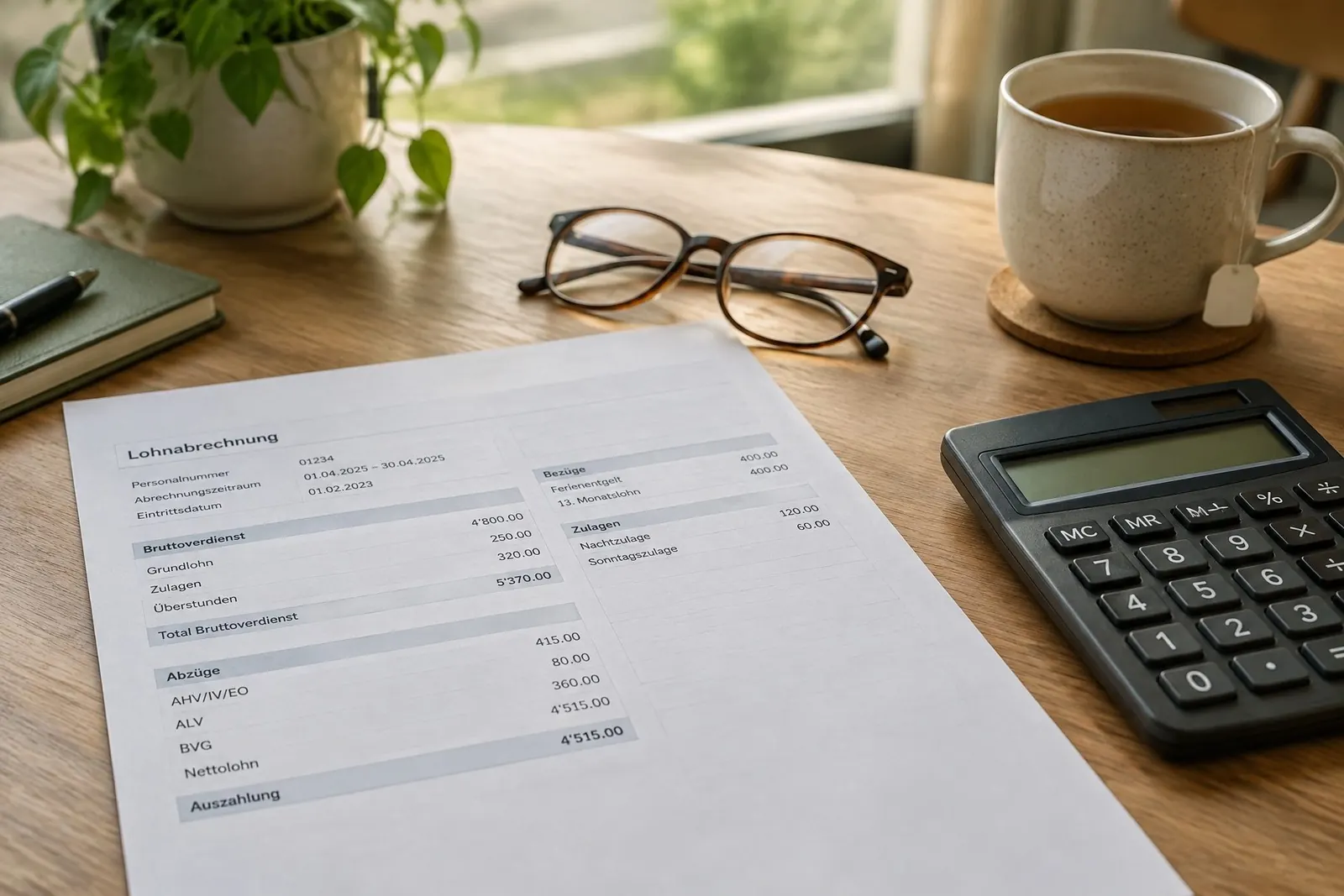
An example payslip
Example only. The numbers below are fictional and rounded. They show the structure, not your real deductions.
| Line | Example only (CHF per month) | What it is |
|---|---|---|
| Gross salary (Bruttolohn) | 8,000 | Your salary as in your contract. |
| Child allowance (Kinderzulage) | + 215 | Paid with the salary, not deducted. Amount depends on your canton. |
| AHV/IV/EO (5.3%) | − 424 | State pension, disability and income compensation. |
| ALV (unemployment insurance) | − 88 | Insurance if you lose your job. |
| Pension fund (BVG / Pensionskasse) | − 400 | Your occupational pension. Fictional amount. |
| Non-work accident insurance (NBU) | − 60 | Accidents in your free time. Fictional amount. |
| Withholding tax (Quellensteuer) | − 900 | Income tax without a C permit. Fictional amount. |
| Net salary paid | 6,343 | What lands in your account. |
The lines, one by one
AHV/IV/EO
This is the first pillar: old-age and survivors’ insurance (AHV), disability insurance (IV) and income compensation (EO, which also pays maternity and paternity leave). The total contribution is 10.6% of your salary: 8.7% AHV, 1.4% IV, 0.5% EO. You pay half, 5.3%, and your employer pays the other half. There’s no upper limit on the salary.
ALV (unemployment insurance)
You and your employer each pay a share, up to a maximum insured salary. If you lose your job, this insurance pays a daily allowance under certain conditions.
Pension fund (BVG / Pensionskasse)
The second pillar. If you earn more than CHF 22,680 a year (2026), your employer must insure you in a pension fund. From 2027 the threshold is CHF 23,040. Contributions depend on your employer’s plan and your age. Your employer pays at least as much as you do. The pension fund also covers death and disability.
Accident insurance (UVG)
Work accidents are paid by your employer. If you work at least 8 hours a week for the same employer, you’re also insured against non-work accidents (NBU). This part is often deducted from your salary. Because you’re covered here, you can pause accident cover in your health insurance and save premium.
Daily sickness allowance insurance (KTG)
Some employers insure loss of salary during illness and share the premium with you. It’s not on every payslip.
Withholding tax (Quellensteuer)
If you live in Switzerland without a C permit, your employer deducts income tax directly from your salary. The exception is if you’re married to a Swiss citizen or a C permit holder. The tax covers federal, cantonal and municipal tax, and the rates are cantonal.
Look for your tariff code on the payslip:
| Code | Meaning |
|---|---|
| A | Single |
| B | Married, spouse not working |
| C | Married, both working (the other spouse’s income is assumed at the median wage of CHF 70,500) |
| H | Single parent |
The digit after the letter is the number of children. Your religion also matters. If you leave a church, tell your employer and the tax office.
Family allowances
If you have children, child or education allowances are paid with your salary. They’re an addition, not a deduction. Employees with AHV income from CHF 630 a month are entitled. Ask HR for the form.
The annual salary statement
Every year in January or February you receive a salary statement (Lohnausweis / certificat de salaire) for the previous year. Keep it. You need it for a premium reduction application, a subsequent ordinary assessment (NOV) and many other forms.
Above CHF 120,000
If your gross income is CHF 120,000 or more a year, a subsequent ordinary assessment (NOV / TOU) is mandatory, and you’ll file a full tax return every year. Below that, you can apply voluntarily by 31 March of the following year. That decision is irrevocable, so take your time.
What to check every month
- Your name, AHV number and address.
- Your tariff code, marital status and number of children.
- The gross salary and any bonuses.
- Family allowances, if you have children.
Report wrong data to HR right away. A simple correction (wrong salary, wrong tariff) doesn’t open the door to extra deductions, but it does fix the tax.
Local tip
Save every payslip as a PDF in one folder. Landlords, banks and the tax office will ask for them, often at short notice.
Related tasks
Sources and last update
Last checked: November 2026
- AHV/IV/EO 10.6% (8.7 / 1.4 / 0.5), employee share 5.3%, as of 1 January 2026: AHV/IV leaflet 2.01, https://ahv-iv.ch/p/2.01.d (checked November 2026)
- No rate change on 1 January 2026: Revisions 1st pillar, https://www.shop.ahv-iv.ch/data/docs/de/1485/Revisionen-1.-S%C3%A4ule-Stand-1.-Januar-2026.pdf
- BVG entry threshold 2026 and 2027: BSV, https://www.bsv.admin.ch/de/newnsb/BqB41FVYi5FB
- Accident insurance (8 hours): BAG, https://www.bag.admin.ch/de/unfallversicherung-wer-ist-obligatorisch-versichert
- Withholding tax, tariff codes: https://ch.ch/de/quellensteuer ; ESTV calculation basis 2026, https://www.estv.admin.ch/dam/de/sd-web/nuQbhdzXDPm0/qst-berechnungsgrundlagen-2026-de.pdf
- Family allowances: BSV, https://www.bsv.admin.ch/de/familienzulagen-leistungen-und-voraussetzungen
firstweeks provides general information, not legal or tax advice. Rules can change. Always check with the responsible authority.