Swiss permits explained: L, B, C and G in plain words
The short version
- If you stay in Switzerland for more than three months, you need a permit. Which one depends on your nationality, your contract and why you’re here.
- EU/EFTA nationals get their permit almost automatically under free movement. Everyone else, including UK nationals since 2021, needs the employer to apply first.
- The letters stand for: L short stay, B residence, C settlement, G cross-border commuter. There are a few special ones, like Ci.
On this page
Why the letter matters
Your permit letter decides how long you can stay, how easily you can change jobs, whether your family can join you and, in many cases, how you’re taxed. Anyone staying in Switzerland for more than three months needs a permit, and the rules depend on your nationality, the length of your stay and its purpose.
The biggest dividing line is your passport:
- EU/EFTA nationals fall under the free movement agreement. If you have a job, you’re entitled to a permit.
- Everyone else (“third-country nationals”) falls under the Swiss Foreign Nationals and Integration Act. Permits are limited, and your employer has to apply for you. UK nationals have been treated like third-country nationals since 1 January 2021, with special rules for people who already lived here before that date.
The four main permits at a glance
| Permit | What it is | EU/EFTA nationals | Third-country nationals |
|---|---|---|---|
| L | Short-term residence | Contract of 3 to 12 months. Valid as long as the contract, can be extended to a total of less than 12 months | For shorter assignments. Usually tied to a specific job |
| B | Residence | Contract of 1 year or more, or open-ended. Valid for 5 years | Limited in time and renewed regularly |
| C | Settlement | After 5 years (EU-15 and EFTA), usually 10 years for other EU states | Normally after 10 years, the last 5 without a break on a B permit, plus integration criteria |
| G | Cross-border commuter | You live in an EU/EFTA country, work in Switzerland and go home at least once a week | Special conditions apply |
Work contracts of less than three months in a calendar year don’t need a permit for EU/EFTA nationals. Instead, the employer registers the job online through the notification procedure.
EU/EFTA nationals: the simple route
If you’re from the EU or EFTA and you’ll work here for more than three months, you apply for the permit yourself. You register with your municipality within 14 days of arrival, and the permit is part of that registration. In Geneva, you register with the cantonal population office (OCPM), not the municipality.
A few things worth knowing:
- Self-employed? You get a B permit valid for five years, as long as you can show a real self-employed activity when you apply.
- Not working? You can still get a B permit if you have enough money to live on and health and accident insurance.
- Lost your job? You can generally stay at least six months to look for a new one. You need to apply for a job-seeker permit with the cantonal migration office.
- Changing jobs or canton? Your permit is valid for the whole of Switzerland and lets you change jobs. If you move to another canton, register there.
Third-country nationals: a permit you earn, not one you claim
If you’re not from the EU or EFTA, the work permit comes before your move. Only qualified people, for example managers, specialists or university graduates with several years of experience, are admitted, and the number of permits is limited. Your employer files the application. Our article “Moving from outside the EU: how the work permit process works” explains each step.
Once you’re here:
- Changing jobs on a B permit: usually possible without a new permit, unless your permit is tied to a specific job.
- Changing jobs on an L permit: only within the same sector and the same profession, and it needs an application to the canton.
- Moving to another canton: you need the new canton’s agreement before you move. Talk to both migration offices early.
Getting a C permit
The C permit is the big milestone: it’s open-ended and frees you from many of the restrictions above, including withholding tax.
- EU-15 and EFTA nationals: after five years of continuous residence. For other EU states, the rule is usually ten years.
- Third-country nationals: normally after ten years, with the last five years on a B permit without interruption, and you must meet the integration criteria. Nationals of some countries with a settlement agreement (including the UK, the USA and Canada) can get it after five years. Well-integrated B holders can apply early.
- Language (third-country nationals only): for the ordinary C permit, A2 spoken and A1 written in the local national language; for the early C permit, B1 spoken and A1 written.
The C permit itself doesn’t expire, but the card is checked every five years.
Family members
- EU/EFTA nationals can bring their spouse, children and grandchildren under 21 (or older if dependent) and dependent parents and grandparents, as long as the home is suitable for the whole family. Family members who come this way may work, whatever their nationality.
- Third-country nationals with a B or C permit: the spouse and children may work anywhere in Switzerland without a separate work permit. Their right is tied to the main permit. For family reunification, the spouse needs A1 spoken in the local language, or must be enrolled in a course.
- Third-country nationals with an L permit: family members have no automatic right to work. An employer has to apply for them, like for any other work permit.
- Spouses of Swiss nationals or C holders don’t need a work permit.
Deadlines for bringing your family over exist for third-country nationals. Ask the migration office before you plan the move.
The special ones: Ci and others
- Ci: for the spouses and children (up to age 25) of people working for foreign representations (embassies, missions) and intergovernmental organisations. It allows paid work and is valid as long as the main holder’s job lasts. You’ll meet it mostly in Geneva and, to a smaller degree, in Vaud.
- F, N and S are for people in the asylum and protection system and aren’t covered in this guide.
Renewing your permit
- Apply no earlier than three months and no later than two weeks before your permit expires.
- In Basel-Stadt and Geneva you apply directly to the canton. In Zürich, Zug and Vaud, you start at your municipality.
- Bring your current permit and a valid passport or ID. Third-country nationals: your passport must be valid for at least three more months after the permit expires.
- Renewals and new cards cost a fee. Amounts vary by canton.
Your permit card
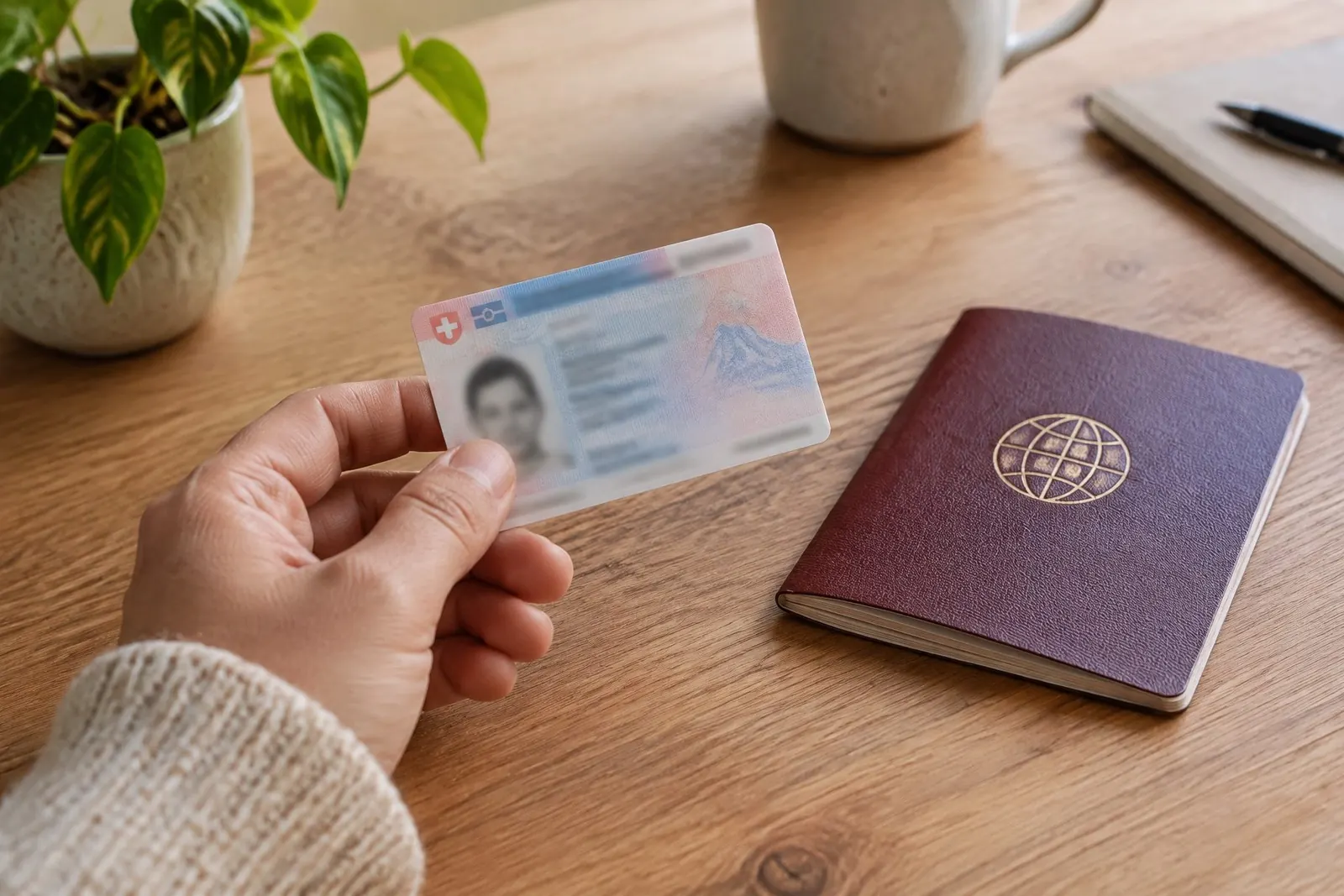
Third-country nationals (and family members of Swiss and EU/EFTA nationals who are third-country nationals) get a credit-card-sized biometric permit with a chip that stores your photo and two fingerprints. Your canton takes the biometric data, and the card is produced centrally. With a valid passport and this card, you can travel in the Schengen area without a visa.
Local tip
Put your permit’s expiry date in your calendar twice: three months before (when you can first apply) and four weeks before (your personal last call). Missing the window doesn’t end your stay overnight, but it makes travel and job changes much harder than they need to be.
Related tasks
In your city
Sources and last update
Last checked: November 2026
- ch.ch, Swiss residence permits, application and renewal: https://www.ch.ch/en/documents-and-register-extracts/permits-for-living-in-switzerland/
- ch.ch, Working in Switzerland as a foreign national: https://www.ch.ch/en/foreign-nationals-in-switzerland/working-in-switzerland/
- SEM, FAQ free movement of persons: https://sem.admin.ch/sem/en/home/themen/fza_schweiz-eu-efta/eu-efta_buerger_schweiz/faq.html
- SEM, L EU/EFTA permit: https://www.sem.admin.ch/sem/en/home/themen/aufenthalt/eu_efta/ausweis_l_eu_efta.html
- SEM, factsheet “Residing in Switzerland and taking up gainful activity” (SP_01/25): https://www.sem.admin.ch/dam/sem/en/data/eu/fza/personenfreizuegigkeit/factsheets/fs-bew-aufenthalt-e.pdf.download.pdf/fs-bew-aufenthalt-e.pdf
- SEM, Ci EU/EFTA permit: https://www.sem.admin.ch/sem/en/home/themen/aufenthalt/eu_efta/ausweis_ci_eu_efta.html
- SEM, FAQ work (non-EU/EFTA): https://www.sem.admin.ch/sem/en/home/themen/arbeit/faq.html
- SEM, Biometric residence permits: https://www.sem.admin.ch/sem/en/home/themen/aufenthalt/biometr_auslaenderausweis.html
- Kanton Zug, Aufenthalt und Niederlassung (C permit rules): https://zg.ch/de/migration-integration/einreise-und-aufenthalt/aufenthalt-und-niederlassung
- Migrationsamt Zürich, brochure on language requirements: https://www.zh.ch/content/dam/zhweb/bilder-dokumente/organisation/sicherheitsdirektion/migrationsamt/Brosch%C3%BCre%20Sprachanforderungen.pdf
- ge.ch, Announcing my arrival (OCPM): https://www.ge.ch/annoncer-mon-arrivee-ocpm
- Kanton Aargau, Merkblatt B1720 Familiennachzug Nicht-EU/EFTA (work rights of family members, Art. 26 and 27 VZAE, Art. 46 AIG): https://www.ag.ch/media/kanton-aargau/dvi/dokumente/mika/merkblaetter/erwerbstaetigkeit/b1720-familiennachzug-nicht-eu-efta/b1720-familiennachzug-nicht-eu.pdf
firstweeks provides general information, not legal or tax advice. Rules can change. Always check with the responsible authority.